
End Of Tax Year Planning 2025
One way as Profit Consultants is to pay as minimal tax as you legally can. The current tax year that ends on the 5th April 2025 is right around the corner and this document outlines the main things that you should consider to ensure that your tax affairs are in good order and that you make use of all available tax allowances and exemptions.
Income Tax and National Insurance
Transferring assets to your partner
If you or your partner has insufficient income to make use of their personal tax allowance (currently £12,570) or their nil, basic or higher rate tax bands you may be able to gift sufficient income-producing assets to them to make use of their personal allowance or tax rate bands.
Determining the amount of income-producing assets to transfer can be complicated as you have to consider the interaction of the savings rate of tax and dividend nil rate bands and the possibility of withdrawal of the personal tax allowance if income is over £100,000. Please contact us if you require assistance in this area.
Preserving your personal allowance
When your income is between £100,000 and £125,140, your personal allowance is phased out resulting in an effective tax rate of up to 60%. There are a few ways in which you can reduce your taxable income, such as by making pension contributions and charitable donations. You should consider any other implications of making such payments.
Charitable donations
Cash gifts to UK registered charities are eligible for tax relief and are tax free. Donating through Gift Aid means charities can claim an extra 25p for every £1 you give and the donor can reclaim any extra tax through their tax return.
As an example, if a 45% taxpayer makes a cash donation of £20,000 to a charity under the Gift Aid Scheme then the charity can reclaim £5,000 from HMRC (making a gross donation of £25,000) and the donor will obtain tax relief of £6,250 through their personal tax return. The charity therefore receives £25,000 at a net cost to the donor of £13,750.
Optimise Use of Annual Pension Allowance
You might also want to consider increasing your pension savings before 5 April 2025. Making full use of your personal pension allowance can be tax-efficient. The annual allowance for 2024/25 is £60,000. This is the amount of tax-deductible contributions that an individual can make into their pension scheme. The allowance is reduced by £1 for every £2 of income above £260,000, subject to a minimum allowance of £10,000.
Under the current rules, the government adds to your pension contributions at the 20% basic rate. For instance, if you save £4,000 in a personal pension, the government tops this up to £5,000. If you are a higher rate taxpayer there is a further £1,000 tax relief when your tax liability is calculated, reducing the net cost to £3,000.
Additional pension contributions can be even more effective if your income is between £100,000 and £125,140. If you have income in excess of £100,000, your £12,570 personal allowance may be tapered. For every £2 of income in excess of £100,000, the personal allowance is reduced by £1, reducing to nil where net income is £125,140 or more. The gross pension contribution reduces net income for the purposes of calculating the reduction in the personal allowance. This is effectively a 60% tax saving.
Any unused personal pension allowance in the last 3 years can be carried forward and used in the current year. Therefore, unused allowances from 2021/22 onwards can be used in 2024/25. You should consider this before the end of the current tax year.
Are your investments held in a tax-efficient structure?
When you make investments, you need to consider the effect of the different rates of tax for corporation tax, income tax and Capital Gains Tax.
• The main rate of corporation tax is currently 25% with smaller companies taxed at a lower effective rate of between 19% and 25%.
• For 2024/25 the additional rate of income tax is 45% for most income and 39.35% for dividends, after the £500 dividend nil rate bad. (The nil rate band was £1,000 for the 2023/24 tax year)
• For 2024/25 there is a Capital Gains Tax annual exemption of £3,000. (This was £6,000 for the 2023/24 tax year). For residential property gains the top rate of Capital Gains Tax is 24% (18% for basic rate taxpayers). Most other gains are taxable at 24% for gains from 30 October 2024 onwards (18% for basic rate taxpayers) and 20% for gains before 30 October 2024 (10% for basic rate taxpayers).
Given the differing tax rates set out above, you should review your investments to ensure that they are held in the most tax efficient way.
Capital Gains Tax (CGT)
Capital Gains Tax Annual Allowance
In 2024/25 each individual has a CGT tax free allowance of £3,000. This cannot be carried forward and is lost if it is not used. You may wish to consider bringing forward capital gains to before 6 April 2025 if you have not used your allowance for that year.
Tax relief for capital losses
Capital losses must be claimed within four years of the end of the tax year in which the loss is realised. Therefore, by 5th April 2025 you must claim any capital losses realised in 2020/21. It is important to consider whether you have any losses to claim that have not previously been claimed.
It may also be possible to claim a capital loss if you own assets or investments that have fallen in value and are now worthless or if you have made loans to a trading company that have become irrecoverable.
Where the capital loss relates to shares in an unquoted trading company it may be possible to offset the loss against income, saving tax at up to 45%.
Business Asset Disposal Relief
From 30 October 2024 onwards the top rate of Capital Gains Tax is 18% on gains on most assets and 24% on residential property. A reduced rate of 10% is available for gains that qualify for Business Asset Disposal Relief (BADR). The lifetime limit for BADR is £1m making this an important tax saving.
Note that in the Autumn Budget it was announced that from 6 April 2025 the CGT rate for BADR will be increasing to 14% with a further increase to 18% from 6 April 2026. This may affect your decision on the timing of disposals.
Investors’ Relief
Investors’ relief is also available to reduce the CGT rate to 10%. The lifetime limit for this relief was £10m for disposals prior to 30 October 2024 and has been reduced to £1m for disposals on or after that date. The relief is available for individuals who purchased newly issued shares in an unlisted trading company paid for in cash on or after March 2016. The individual must not be an employee or paid director in the company and the shares need to have been held for at least 3 years.
Note that in the Autumn Budget it was announced that from 6 April 2025 the CGT rate for Investors’ Relief will be increasing to 14% with a further increase to 18% from 6 April 2026. This may affect your decision on the timing of disposals.
Inheritance Tax
All individuals have an inheritance tax annual exemption of £3,000. This is the amount that can be given away each year without any inheritance tax implications. If all or part of the previous tax year’s annual exemption was not used then the balance can be carried forward. This means that up to £6,000 can be given away tax-free in 2024/25.
Savings
If you have some spare cash, an obvious tax planning point might be to maximise your ISA allowances for the 2024/25 tax year (currently £20,000 per person).
If you are 18 or over, but under 40, you can open a Lifetime ISA to save for your first home or retirement. You can put up to £4,000 each year into a Lifetime ISA, until you are 50, but you must make your first payment into your ISA before you are 40. The government will add a 25% bonus to your savings, up to a maximum of £1,000 per year. The £4,000 Lifetime ISA limit counts towards the £20,000 ISA allowance.
Paying Voluntary National Insurance Contributions
A retiring person needs to have 35 ‘qualifying years’ in order to claim the full state pension. For those with gaps in their record, usually due to not paying sufficient National Insurance Contributions (NICs), it is possible to ‘plug’ those gaps by paying Class 3 (Voluntary) NICs at £17.45 per week (£17.75 in 2025/26). Usually, it is only possible to pay Class 3 NICs in respect of the past six tax years, but there is currently an easement in place that allows taxpayers to pay Class 3 in respect of tax years going as far back as 2006. This easement expires on 5 April 2025, so it is worth considering making Class 3 payments before the opportunity is lost.
Stamp Duty Land Tax
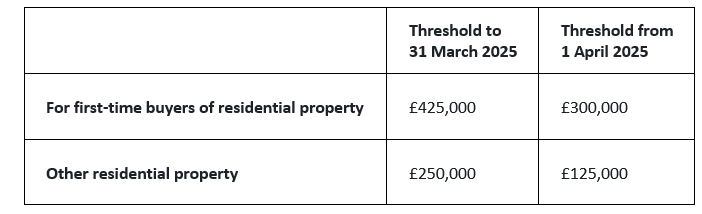
Stamp Duty Land Tax (SDLT) applies to purchases of property in England and Northern Ireland. The following SDLT nil-rate thresholds are set to revert to their previous levels from 1 April 2025, so if possible, accelerating a completion date could be worthwhile in order to make a saving.
Furnished Holiday Lettings
Furnished Holiday Letting (FHL) status has been popular for landlords due to favourable tax rules compared to standard buy-to-let properties. From 6 April 2025 some of these benefits will be abolished, aligning holiday lets with standard residential property tax rules. This will mean an end to the beneficial tax treatment that has been enjoyed by FHL owners up to now. If you own an FHL property, it may be worth considering the cessation of your FHL trade prior to 6 April 2025, so that your ability to claim Business Asset Disposal Relief in the normal period of three years post cessation can be preserved.
Key changes are:
Mortgage Interest Relief – Currently FHL landlords can deduct 100% of mortgage interest from their rental income before calculating tax. From April 2025 tax relief will instead be given in the form of a 20% tax credit. This means a reduction in tax relief for individuals taxed at 40% and 45%. This will increase taxable profit and annual tax payments.
Capital Gains Tax – Currently, FHL landlords benefit from Business Asset Disposal Relief and holdover relief, which reduces the tax payable on property sales. From 6 April 2025 this will no longer be available and landlords will be subject to the higher rates of CGT paid on residential property sales.
Pension Contributions – Tax relief for pension contributions is limited to the higher of £3,600 or 100% of net relevant earnings. Profits from FHL’s have historically been treated as relevant earnings and could be used in pension contribution calculations. Under the new rules FHL profits will no longer qualify as relevant earnings which will reduce the landlord’s ability to use these earnings for tax-advantaged pension contributions.
Capital Allowances – Under current FHL rules landlords can claim capital allowances on furniture, appliances and certain other property fixtures. From 6 April 2025 FHL’s will no longer qualify for capital allowances and landlords will only be able to claim for the cost of replacing domestic items. Any existing capital allowances pool will be carried forward and you can continue to claim writing-down allowances on that pool. Note that you can still claim capital allowances for expenditure on a qualifying FHL prior to 6 April 2025, so you may wish to consider accelerating expenditure.
If you need help on any of these issues or need a profit consultant to improve your figure then contact us today at [email protected].